
Midland Past Residents by Era
The sources for past residents change with the era. Midland has a useful sequence of local directories, telephone volumes, newspaper microfilm, Sanborn map years, and modern property records, but none is continuous. Start with the row nearest to the address period in question. Then make a second comparison before connecting a person to the same location.
| Source | Years it covers | Where held | What it can show |
|---|---|---|---|
| Civic chronology | 1881–1906 | City and county history sources | Railroad, county, and incorporation context before later address records. |
| Sanborn maps and microfilm | Maps 1900–1929; newspaper microfilm from 1929 | Redfern and cited historic-resource sources | Building, street, and event context, not a resident roster. |
| Historical Society directory | 1928 and later listed runs through selected 2004 issues | Midland Historical Society, by appointment | A dated city-directory lead; the archive calls its list incomplete. |
| Telephone and city directories | 1930–2003 with gaps; city runs in several periods | UT Briscoe, Texas State Library, and archive catalogs | Name-and-address clues that need a year and repository citation. |
| County Clerk Official Records | Current portal start year not stated | Midland County Clerk portal and counter | Recorded parties, legal descriptions, and instrument dates. |
| Permit Midland | Online coverage date not located | City public-information search | Dated permit, plan, inspection, code, request, or license activity. |
Midland County was organized in 1885, after the railroad-era arrival in 1881, and the city incorporated in 1906. Those dates explain why an early address may need historical context before it can be compared to later municipal and county records.
Begin Midland Previous Residents with MCAD
Start the backward trail with the Midland Central Appraisal District location search, but keep its labels straight. The observed tax-search screen separates owner address from property location. For the latter, its hint says to use the street number and street name while omitting street type and direction. The account is a present-day locator and tax-record clue. It is not the deed chain and does not establish that every listed party lived at the site.
The assigned Midland CAD tax-account search image is the first record layer for this address-history process.
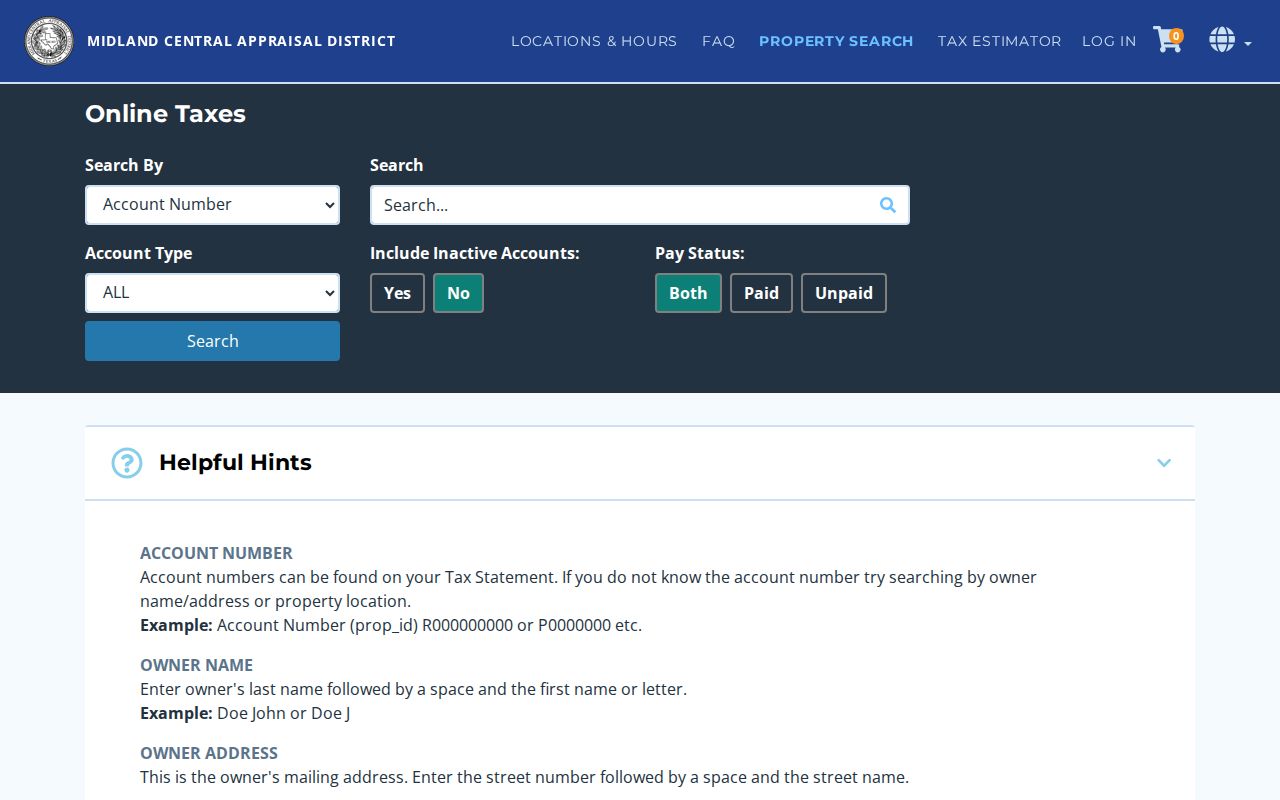
Write down the site address exactly as found, any account clue, and the legal-description language available from the supporting record. If a format fails, retry the location using MCAD's local street-entry hint rather than silently changing the address.
Midland Previous Residents Trail Terms
Three plain definitions keep the Midland trail from collapsing different evidence types into one claim. The legal chain and the household trail are related, but they do not answer the same question.
- Grantor
- The party who conveys or transfers an interest in a recorded instrument.
- Grantee
- The party who receives an interest in that instrument. A grantee is not automatically a current resident.
- Chain of title
- The sequence of recorded interests traced backward through instruments tied to the same property.
- Legal description
- The lot, block, subdivision, or other formal land description used to distinguish a parcel when street names or numbers change.
Use the legal description with the instrument date when names repeat or an older Midland street line does not match the modern address format.
Walk the Midland Deed Chain Backward
The Midland County Clerk's Official Public Records index is the legal-record layer. It includes deeds, deeds of trust, liens, affidavits, powers of attorney, mineral leases, judgments, and other instruments. For a property history, use the current parcel clues to find a recorded party and legal description, then move from the newer instrument to an earlier one. The online portal's beginning year, full image terms, result schema, and export behavior were not located, so do not assume the web index carries the whole chain.
- Use the current MCAD address format and related property clue to identify the parcel being researched.
- Search the Midland Official Records index by the known party, legal description, subdivision, recorded date, or book and page.
- Save the instrument number, recording date, document type, legal description, and each party's stated role before moving to another document.
- Use the newer seller or grantor as a search lead for the earlier acquisition, checking the legal description rather than relying only on an address string.
- Repeat the documented link backward. When the portal does not reach the needed instrument, ask the Clerk counter for the appropriate record or copy channel.
A deed chain records interests and transfers. It does not identify every person who stayed at the address during the interval. Keep the title sequence and the household evidence in separate notes until dated directory, census, newspaper, or other material supports a connection.
Midland Previous Residents in Official Records
The Clerk's Quick Search has an optional Search Term, recorded-date start and end fields, date shortcuts, and Index Only or Index & Full Text search scopes. The quick page displayed certification through August 31, 2026, while the advanced inspection displayed a slightly different August 28 date. Neither observation supplies an online coverage start year. The distinction matters when an old address seems absent from the portal.
Advanced Search adds department, party or grantor/grantee, recorded and instrument dates, document type, document number, book, volume, page, lot, block, legal description, and an OCR phrase. Use the party fields with the role recorded in the document. A later mailing address, a lien party, or a power-of-attorney filing is not a substitute for reading the instrument type and date.
Note: Preserve the document number and recorded date before requesting a copy, because the portal did not expose a verified result-row or image schema.
Pair Midland Directories and Census Material
Past residents are most often confirmed through a dated household trail after the deed work. The Redfern Genealogical Research Center has print, microform, and digital resources, including census material, and staff can assist with copying, obituary searches, surname tracking, and house-history research. Its Midland Reporter-Telegram microfilm reaches back to 1929, but it is described as manual rather than keyword searchable. Bring an approximate date, surname, event type, and address variant for page-by-page work.
- Choose a directory year near the address period and copy the street spelling plus any house or apartment number exactly as presented.
- Check a second nearby directory year from another listed repository when available, noting the repository, publication year, and page after inspection.
- Compare the two dated entries with census material, a deed, permit activity, or a newspaper item to test continuity.
- Use Sanborn map context to check building and street conditions without treating the map as a household record.
The directory runs are catalog leads, not a complete collection. The detailed holdings and how to read them belong with the Midland city-directory collections; the one-address task here is to place each entry in sequence with other dated evidence.
Midland Past Residents: Check Gaps
Insider tip: Midland's directory catalogs overlap but do not line up perfectly. The Historical Society lists a 1928 directory and later selected runs, Texas State Library lists its own series, and UT Briscoe identifies Hudspeth and telephone directories with different gaps. The Historical Society explicitly says its list is incomplete, and one Catoica range appears reversed or mistyped. Call the archive to resolve a questionable year instead of inventing continuity.
The assigned Redfern Genealogical Research Center image highlights a local channel for staffed historical research. Some databases are available only in the center, so an in-person or staff-assisted request can be the useful alternative to an empty online search.
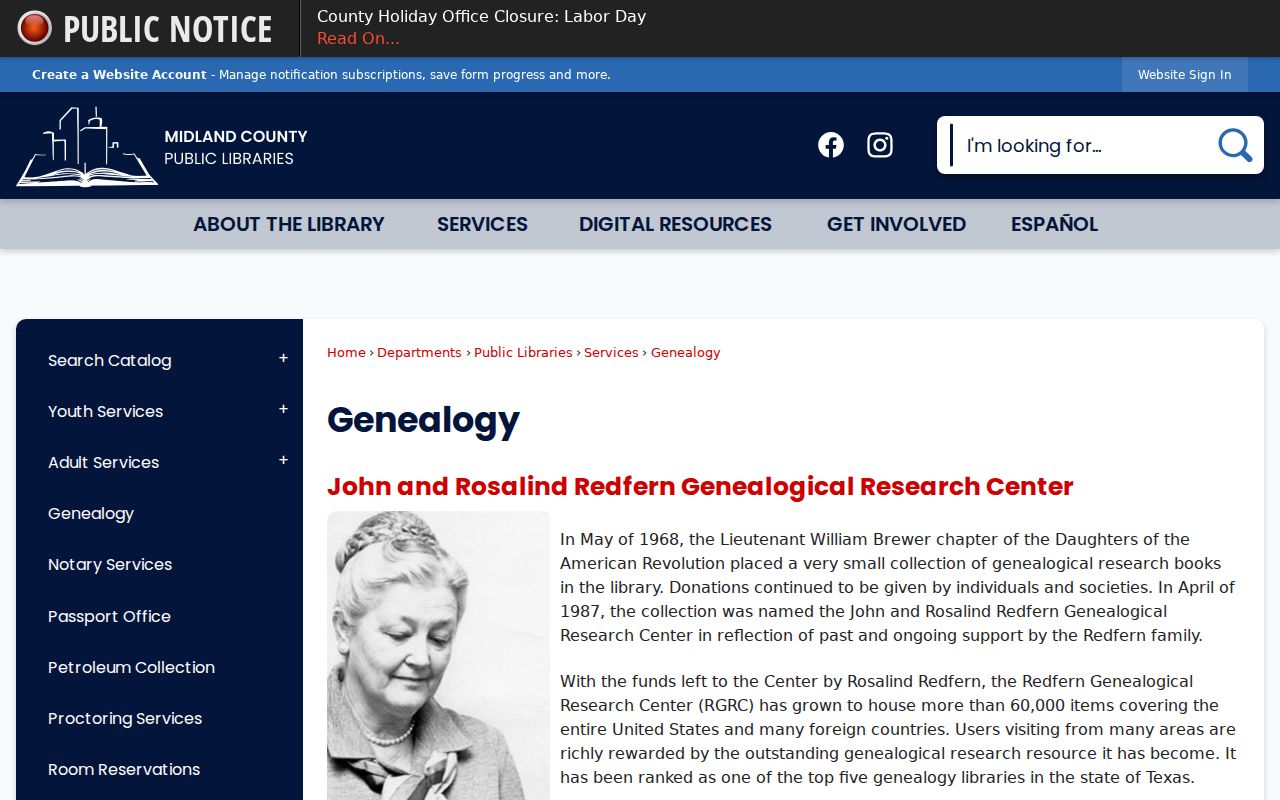
Redfern reports more than 60,000 genealogy items from the United States and abroad. Its house-history material and the library's Texas Sanborn Digital Maps offer context, while the archive and directories provide dated local leads.
Set Midland Past Residents in Context
The Texas Historical Commission's Midland marker places the railroad arrival in 1881, the county's organization in 1885, and the city's incorporation in 1906. These are useful for testing whether a location's name or municipal context belongs to the era being researched. They do not supply a resident list.
The assigned City of Midland history and open-government image supplies the local civic-history source used alongside the address trail.
Use Sanborn years, including 1900, 1905, 1909, 1914, 1925, and 1929, to compare building and street context. The maps show built environment information, not people. They are most useful when a directory or deed raises a question about the place itself.
The assigned Texas Historical Commission Midland marker image provides the companion historical reference.
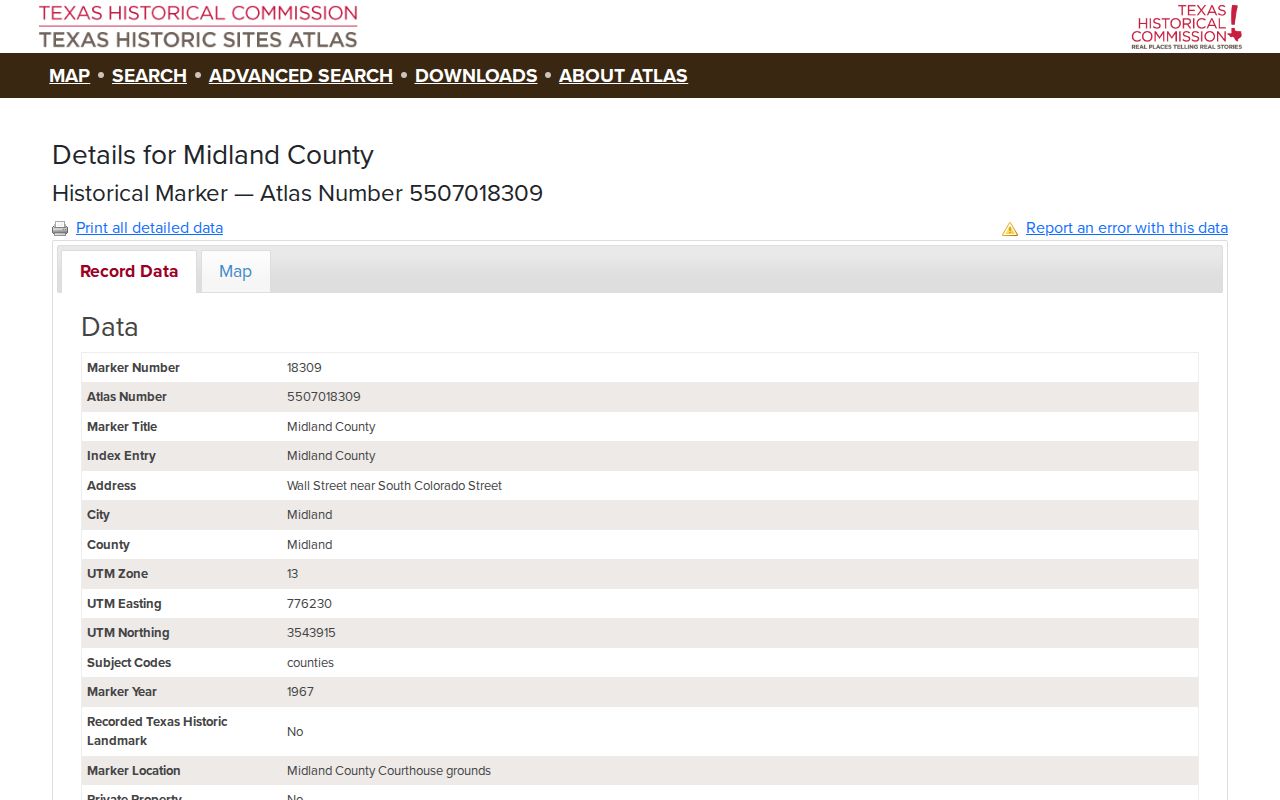
Postal and city labels can also shift over time. Compare the historic street spelling and nearby context with the legal description, rather than forcing an earlier directory line into a modern parcel record.
Midland Past Residents Are Not Just Owners
Myth: a recorded deed proves who lived at the address. A deed documents a transaction or interest and names its parties. It may be central to a Midland title trail, but it does not establish that all parties were present at the property or that no one else was. Historical directories, census material, manual newspaper research, permits, and map context are separate evidence layers.
Permit Midland can search an address across permits, plans, inspections, code cases, requests, and licenses with an All dropdown, keyword or address field, and Exact Phrase option. It may date a physical change or city action. A permit contact still needs context and should not be treated as a household conclusion.
Use Midland Previous Residents Lawfully
Past-resident research is best suited to family history, estate questions, local history, and understanding the sequence of an address. It should preserve uncertainty where sources disagree or leave gaps. The County Clerk counter at 500 N Loraine Street, fourth floor, is the fallback for deed-copy questions and can be reached at 432-688-4401. The Historical Society requires an appointment, and Redfern staff assistance is another documented historical channel.
Lawful use. Use Midland past-resident records for lawful personal and historical research. Do not use them to stalk, harass, intimidate, or harm a living person.
When a result matters, retain the custodian, source type, date, page or document reference, and the limit on what it proves. That recordkeeping makes the one-address trail more reliable than a bare name-and-address claim.